How to actually choose
**Choose quartz if** you want to stop thinking about the countertop. It is non-porous, so it does not need sealing and does not harbor staining the way unsealed stone can. Patterns are consistent, which matters if you have a long run or an island and want the seam to disappear. The one real limitation is heat: the resin binder scorches, so a pan straight off the burner leaves a mark that does not come out.
**Choose granite if** you cook hot and often, or if you want a surface that is genuinely one of a kind. Granite handles heat better than any engineered surface. The trade is porosity — it needs sealing, and how often depends on the specific stone. A dark, dense granite may go three years; a light, open-grained one may want annual attention.
**Choose butcher block if** you want warmth, or you want an island surface that is different from the perimeter. It is the only one of the three you can repair completely: a scorch, a knife score, a water ring all sand out. It is also the only one that will fail if you neglect it, and a kitchen is a wet room.
The Seattle-specific considerations
**Humidity and wood movement.** Wood countertops move seasonally, and Seattle's swing from a damp winter to a dry August is enough to matter. A butcher block top has to be finished on *all six sides* — top, bottom, both ends, both edges — or it will cup. The underside is the one people skip, and it is the one that causes the failure.
**Sink cutouts in wood.** An undermount sink in butcher block means end grain exposed to standing water. It can be done well with an epoxy-sealed cutout, but a drop-in sink is materially more durable in wood.
**Slab yards.** Buy granite by selecting the actual slab, not a sample chip. Slabs from the same quarry lot vary enormously. If the vein pattern matters to you, go to the yard and tag your slab.
What your cabinets have to do
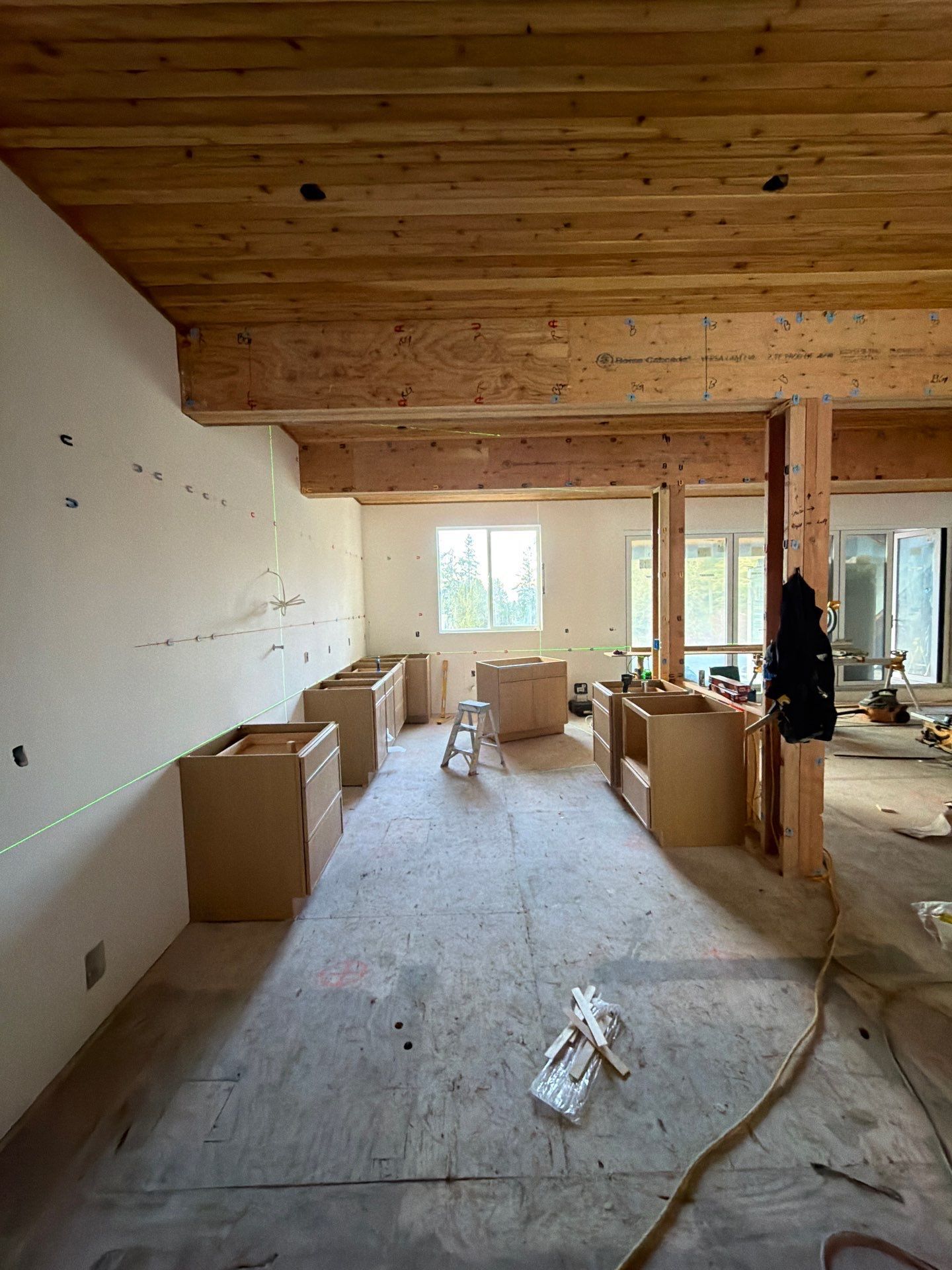
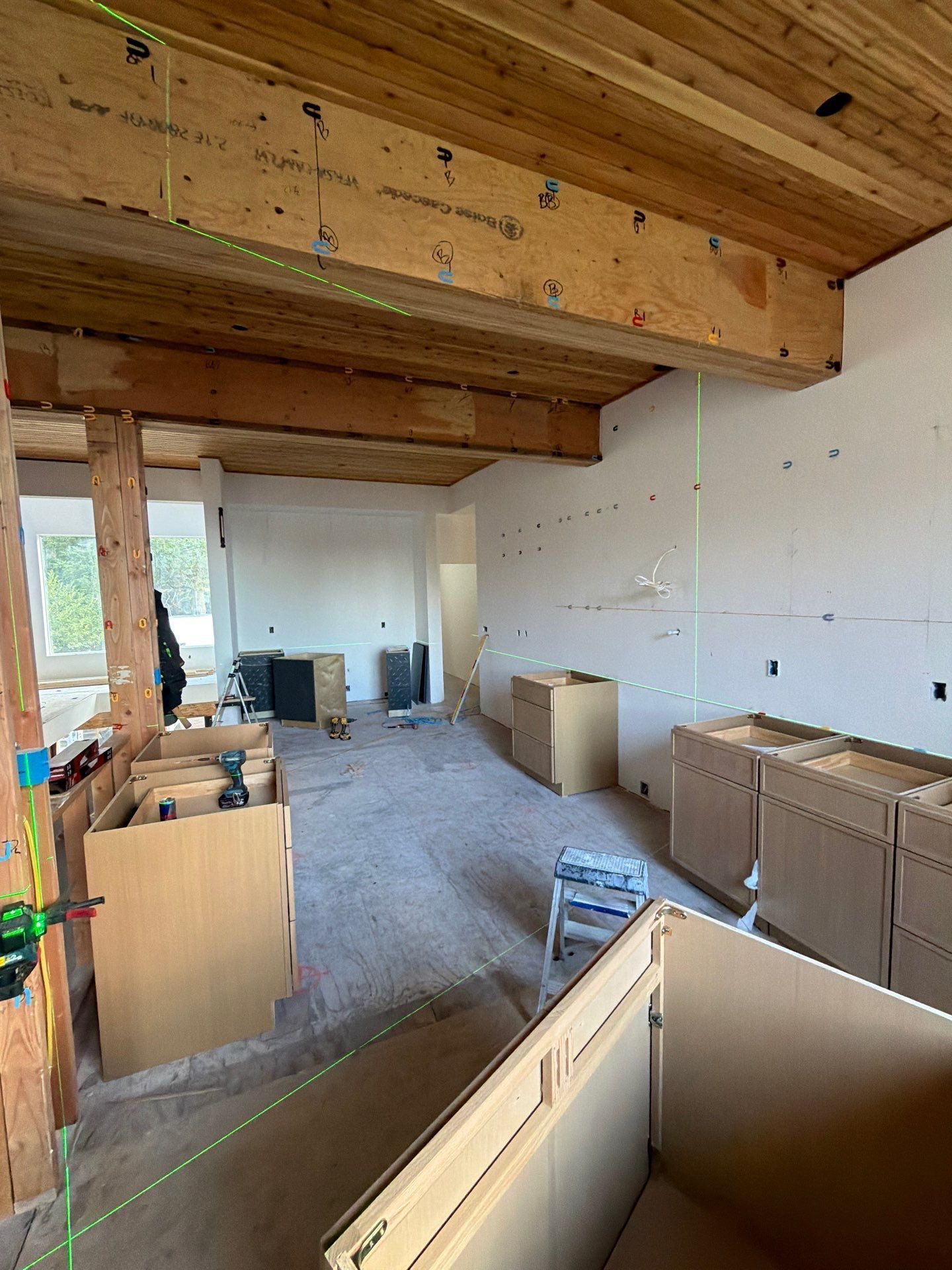
A stone top is heavy: quartz and granite run roughly 18–22 pounds per square foot in a 3 cm slab. That load sits on the cabinet boxes, so the boxes have to be level, plumb and shimmed solid before templating. If the run has a dip in it, the fabricator's template records the dip and the finished top follows it.
Three things we set before anyone templates:
1. Cabinet tops laser-leveled across the whole run, shimmed, and fastened
2. Overhangs supported — anything past about 10 inches of unsupported stone needs hidden steel or corbels
3. Cutouts confirmed against the *actual* sink and cooktop on site, not the spec sheet
The mixed-material approach
The most common outcome in the kitchens we build: quartz on the perimeter where the sink, the dishwasher and the daily wet mess live, and butcher block on the island where people sit, chop and set things down. You get the maintenance-free wet zone and the warm working surface, and the visual break between the two makes the island read as a separate piece of furniture — which, in an older Seattle house, usually suits the room.
How Fortress Build & Finish handles countertops
We build the cabinetry, set it dead level, and coordinate the template directly with the fabricator so the seam locations, the overhang supports and the cutouts are decided before the slab is cut — not negotiated on installation day. If you're going with butcher block, we finish all six sides before it goes in.
Frequently asked questions
Is quartz better than granite?
Neither is better across the board. Quartz needs no sealing and is more stain-resistant; granite handles heat far better and every slab is unique. Pick on how you cook and how much maintenance you want.
Do quartz countertops stain?
Rarely. Quartz is non-porous, so liquids sit on the surface. The realistic risks are heat scorching from a hot pan and, on some resins, yellowing in direct sunlight.
How often does granite need to be sealed?
Every one to three years, depending on the stone. Test it: drop water on the surface and let it sit 15 minutes. If it darkens, it's time to re-seal.
Can you put a hot pan on butcher block?
No. Wood scorches. The upside is that a scorch sands out completely — the same is not true of quartz.
What is the cheapest durable kitchen countertop?
Butcher block has the lowest purchase price of the three, but its lifetime cost includes regular oiling. For a low-maintenance surface at the lowest cost, a mid-range quartz is usually the better value.
---
**About the author.** Ryan Watt is the marketing director at Fortress Build & Finish, a Seattle-owned finish contractor with more than 25 years in residential and commercial remodeling, custom carpentry, tile installation, and fire and water damage restoration.
*Fortress Build & Finish —
(206) 426-2067 · Licensed, bonded and insured — License No. FORTRBF756KA · Serving Seattle, Ballard, Magnolia, Queen Anne, West Seattle, Capitol Hill, Wallingford, Bellevue, Kirkland, Renton, Shoreline, Edmonds and the surrounding communities ·
fortressbuildfinish.com*