**4. Note the business history.** A company registered eight months ago, run by someone whose previous registration ended with claims against it, is a pattern the record will show you.
**5. Ask the insurer directly.** Request the certificate of liability insurance be sent to you *by the agent*, not forwarded by the contractor. Certificates are easy to alter.
What the tool won't tell you
- **Whether they're good.** No exam requirement, no quality rating. The record shows financial and legal standing, not craft.
- **Whether they use subcontractors,** and whether those subs are registered and insured. Ask separately.
- **Whether they'll finish on time.**
- **Small claims history** in county courts, which is separate.
For the quality question, you still need references, finished work you can visit, and specific questions about tolerances and methods.
Additional checks worth doing
**Washington Secretary of State.** Confirm the business entity is active and check how long it's been registered.
**Seattle SDCI permit records.** Searchable. Look at permits pulled under the contractor's name — it tells you whether they actually pull permits and what kind of work they do.
**Court records.** King County Superior Court records are searchable for civil suits.
**Better Business Bureau, Google, Houzz, Angi.** Read the negative reviews and, more importantly, the responses. How a contractor answers a complaint is more informative than the complaint.
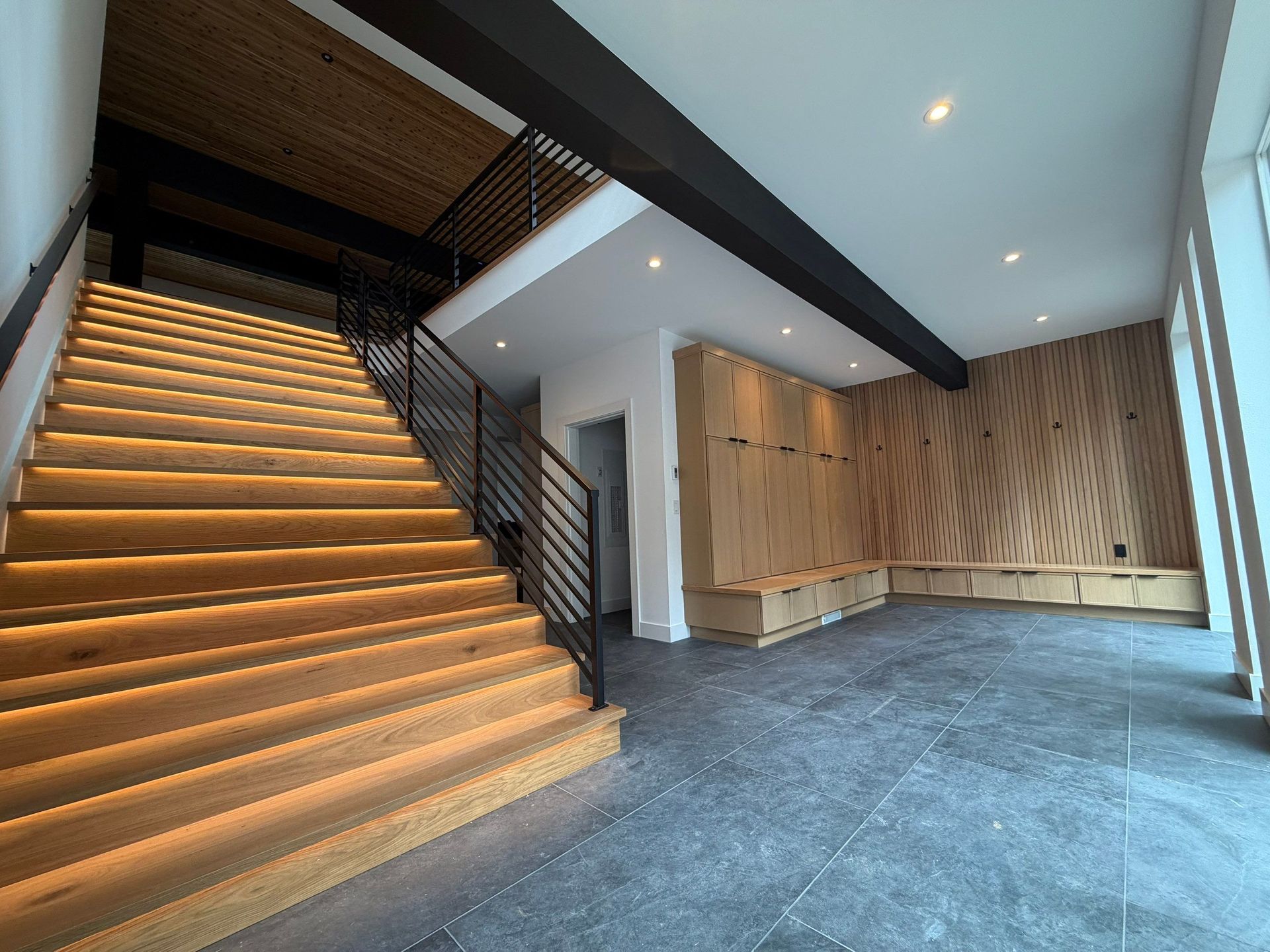
**A finished job you can visit.** Ask for something completed two years ago, not two months ago. Sight down a long cabinet run. Look at the caulk joints, the grout, the reveals, whether the doors still hang parallel.
Red flags
- **No registration number,** or one that doesn't verify
- **Expired or suspended status**
- **Bond below the current requirement** with no explanation
- **Multiple recent lawsuits against the bond**
- **A brand-new registration** for someone claiming twenty years of experience — ask what the previous entity was
- **A specialty registration** for general contracting work
- **Insurance certificate forwarded by the contractor** rather than sent by the agent
- **Asking you to pull the permit** for work they're performing
- **Cash-only, or a discount for paying cash**
If something goes wrong
**The bond** is the primary remedy. A homeowner can file suit and make a claim against a contractor's bond for breach of contract, negligent work or unpaid amounts. Note that the bond is a fixed pool — if multiple claims are filed, it's shared, which is exactly the concern L&I cited when raising the amounts in 2024.
**L&I complaints.** L&I accepts complaints about unregistered contracting and certain violations.
**Attorney General consumer complaints.** Washington's AG handles consumer protection complaints.
**Small claims court** for amounts under the statutory limit; superior court above it.
**Time limits apply** to bond claims. If a project has gone wrong, don't wait — the deadline is shorter than most people assume.
What Fortress Build & Finish's record looks like
Registration **FORTRBF756KA**, active, verifiable at L&I. Licensed, bonded and insured. The number is on every permit we pull, every estimate we write and every ad we run.
We'd encourage you to run this check on every contractor you're considering, including us. It takes five minutes, and a contractor who hesitates to give you the number has answered a different question than the one you asked.
Frequently asked questions
How do I check if a contractor is licensed in Washington State?
Use L&I's Verify a Contractor, Tradesperson or Business tool at lni.wa.gov. Search by business name or registration number.
What bond amount does a Washington contractor need?
As of July 1, 2024, $30,000 for general contractors and $15,000 for specialty contractors — increased from $12,000 and $6,000.
Does Washington require a contractor exam?
No. Washington uses a registration model rather than competency licensing, so there's no statewide trade exam for general contractor registration. Registration means financially accountable and insured, not proven skilled.
What does "licensed, bonded and insured" mean in Washington?
Registered with L&I, carrying the required surety bond, and carrying general liability insurance at or above the state minimums.
What can I do if a contractor does bad work in Washington?
File suit and claim against the contractor's bond, file a complaint with L&I, and consider a consumer complaint to the Attorney General. Bond claims have time limits, so act promptly.
---
Fortress Build & Finish —
(206) 426-2067 · Licensed, bonded and insured — License No. FORTRBF756KA · Serving Seattle, Ballard, Magnolia, Queen Anne, West Seattle, Capitol Hill, Wallingford, Bellevue, Kirkland, Renton, Shoreline, Edmonds and the surrounding communities ·
fortressbuildfinish.com